Shopify vs Shopify Plus: Pricing, Features, and Cost Comparison in 2026
Shopify vs Shopify Plus is one of the most important comparisons for growing ecommerce brands in 2026. While Shopify works well for small and medium-sized stores, Shopify Plus offers advanced automation, checkout customization, B2B tools, and enterprise-level support. In this guide, Doran Apps compares Shopify vs Shopify Plus pricing, features, transaction fees, and scalability to help you decide which platform best fits your business growth stage.
Shopify vs Shopify Plus Comparison Table
Moving from standard Shopify plans to Shopify Plus requires understanding the key differences in features, scalability, and operational capabilities. The comparison table below shows how important ecommerce functions vary across each plan.
| Feature | Shopify | Shopify Plus |
|---|---|---|
| Pricing | Starts from $39/month | Starts around $2,300/month |
| Best For | Small to mid-sized businesses | High-growth and enterprise brands |
| Transaction Fees | Standard Shopify fees apply | Lower transaction fees available |
| Checkout Customization | Limited | Advanced checkout customization |
| Automation | Basic automation apps | Shopify Flow included |
| B2B Tools | Limited support | Native B2B and wholesale features |
| Multi-Store Management | Manual management | Better organization for multiple stores |
| Support | Standard 24/7 support | Priority support and dedicated assistance |
| Scalability | Suitable for growing stores | Built for high-volume operations |
Shopify vs Shopify Plus Pricing
One of the biggest differences between Shopify and Shopify Plus is the pricing structure. Shopify offers predictable monthly subscription plans that are suitable for startups and small businesses, while Shopify Plus targets enterprise merchants with more advanced operational needs.
| Plan | Monthly Pricing | In-person Transaction Fees | Online Transaction Fees | 3rd-Party Payment Providers |
|---|---|---|---|---|
| Basic Shopify | Starting at $39/month | 2.6% + 10¢ | 2.9% + 30¢ | Additional 2.0% fee |
| Shopify | Starting at $105/month | 2.5% + 10¢ | 2.6% + 30¢ | Additional 1.0% fee |
| Advanced Shopify | Starting at $399/month | 2.4% + 10¢ | 2.4% + 30¢ | Additional 0.6% fee |
| Shopify Plus | Starting around $2,300/month | Custom rates available | Competitive custom rates | Lower negotiated fees available |
Although Shopify Plus pricing has a much higher monthly cost, many fast-growing businesses consider it a long-term investment rather than just an expense. The platform provides advanced operational capabilities that can improve efficiency and support larger sales volumes.
Shopify vs Shopify Plus Features
While both Shopify and Shopify Plus share the same core ecommerce infrastructure, Shopify Plus provides significantly more flexibility, automation, and enterprise-level functionality. The differences become more noticeable as businesses scale operations, expand internationally, or manage complex B2B workflows.
For small and medium-sized stores, Shopify offers enough tools to run and grow an online business efficiently. However, larger brands often require deeper customization, advanced automation, and higher operational control - areas where Shopify Plus becomes more valuable.
Below are the most important feature differences between Shopify and Shopify Plus.
Checkout Customization
Checkout customization is one of the biggest advantages of Shopify Plus. Let's break down the difference between Shopify vs Shopify Plus in terms of checkout customization.
Standard Plans only let you change colors, logos, and customize the final Thank You page.
Shopify Plus gives you total control to add custom fields, upsells, and custom logic to every step of the checkout process.
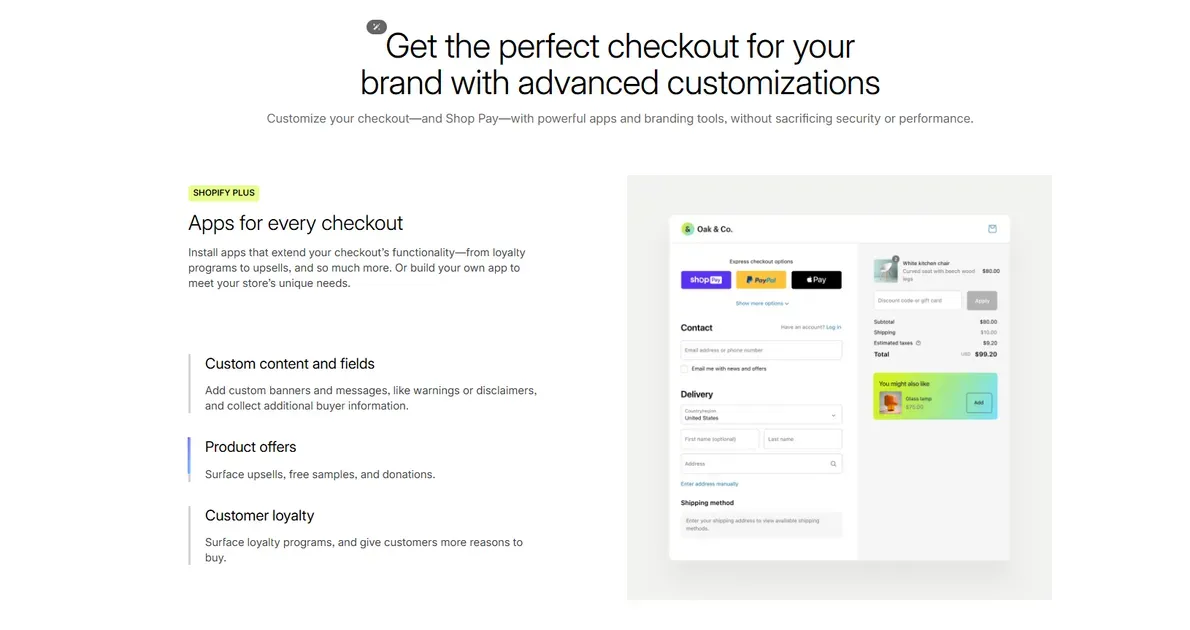
Use Standard if you just want a clean, fast checkout that matches your brand colors. Upgrade to Plus if you need to add custom data fields, run complex B2B/wholesale rules, or want to trigger upsells right before a customer pays.
Automation with Shopify Flow
When it comes to automation, the difference between standard Shopify vs Shopify Plus is much smaller than before. Shopify now gives all paid plans access to Shopify Flow, including Basic Shopify, allowing merchants to automate many daily tasks for free.
Standard Shopify users can use Shopify Flow to automate tasks such as tagging orders, sending slack notifications, managing inventory alerts, and organizing customer workflows
Shopify Plus provides higher API limits, better multi-store management, and exclusive tools like Launchpad for automating flash sales and large campaigns.
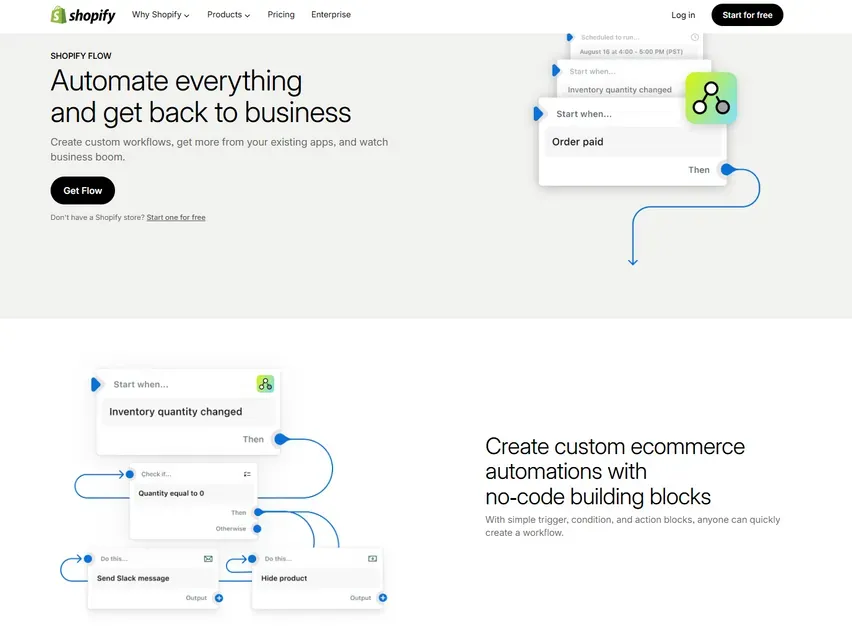
In short, standard Shopify plans are now powerful enough for most automation needs, while Shopify Plus is better suited for enterprise brands handling more complex operations and higher sales volumes.
B2B and Wholesale Tools
While Standard Shopify relies heavily on third-party apps and workarounds for wholesale, Shopify Plus features B2B on Shopify - a powerful suite of native enterprise tools built directly into the core platform.
Standard Plans do not have built-in B2B functionality. To sell wholesale, you must either use third-party apps (which can clash with discounts or inventory) or build an entirely separate second store.
Shopify Plus lets you run retail and wholesale from the exact same store. It natively handles complex company hierarchies, custom price lists, and wholesale payment terms during checkout.
Here is the quick, side-by-side comparison of how B2B and wholesale operations stack up.
| Wholesale Feature | Standard Shopify (Basic / Shopify / Advanced) | Shopify Plus |
|---|---|---|
| Storefront Architecture | Requires a separate Shopify store or 3rd-party apps to lock content. | All-in-One. Run DTC and B2B out of the same backend and domain. |
| Company Profiles (Multiple locations & buyers) | ❌ No. Customers are treated as individuals. | Native. Link multiple buyers, locations, and permissions to one corporate account. |
| Custom Pricing & Catalogs | ❌ Requires apps. Hard to manage volume discounts dynamically. | Native. Assign fixed or percentage-off price lists to specific companies. |
| Payment Terms (e.g., Net 30, Net 60) | ❌ Not supported at checkout without apps. | Native. Customers can checkout with "Net 30" without paying upfront; invoices track automatically. |
| B2B Checkout & Vaulting | Standard checkout only. | Vaulted credit cards, custom tax exemptions, and purchase order (PO) numbers at checkout. |
| Quick Order Sheets | ❌ No. Buyers must browse like retail customers. | Native. Optimized matrices for buying bulk sizes, colors, and quantities quickly. |
Standard Shopify works fine if wholesale is just a tiny fraction of your business managed via apps or basic discount codes. However, if B2B is a core revenue driver, Shopify Plus is mandatory to unlock native tools like Net payment terms, complex tier pricing, and custom portals where enterprise buyers can self-manage and reorder shipments without talking to sales.
Multi-Store Management
Managing multiple storefronts looks completely different depending on whether you are using a standard plan with Shopify vs Shopify Plus organization structure.
While standard plans force you to keep your operational logic inside a single digital dashboard, Plus allows you to spin up entirely separate, standalone store instances that are unified under a single parent login.
Standard Plans use a "One Store, Multiple Markets" model. You manage everything from a single backend, using Shopify Markets to tweak pricing, language, or themes for different countries.
Shopify Plus uses a "Multi-Store Organization" model. You get up to 9 free expansion stores under your single contract, allowing you to run entirely independent websites (with different product catalogs, integrations, and apps) while managing user access and analytics from a centralized Organization Admin panel.
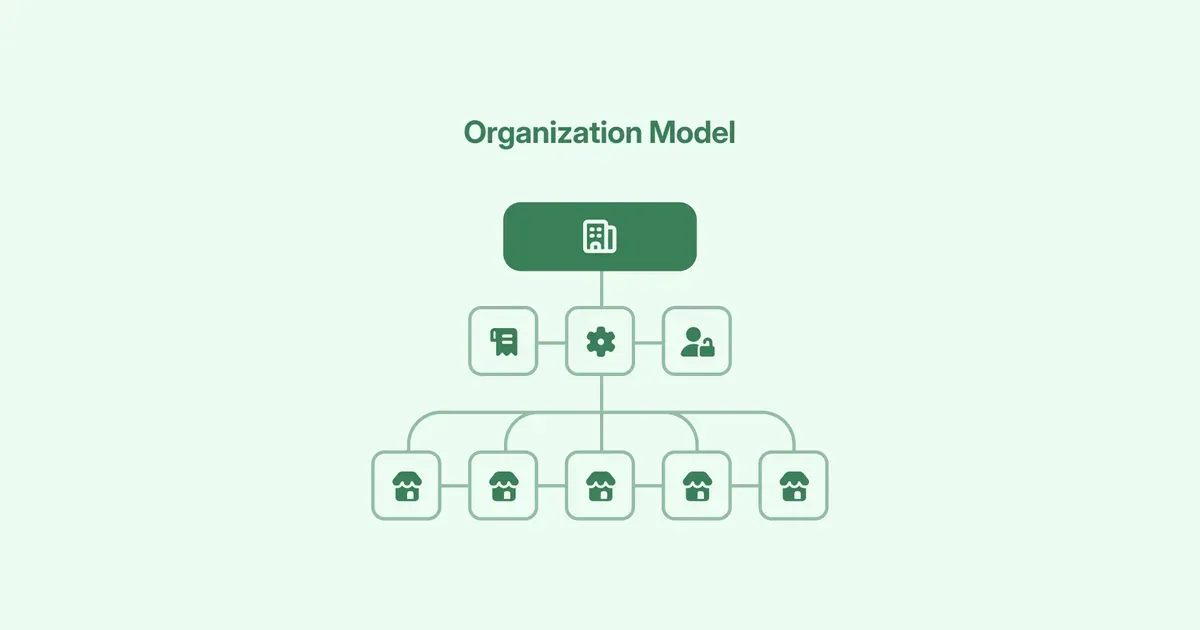
Standard Shopify uses a single dashboard to tweak language, currency, and domains for different regions, making it perfect if you sell the same inventory everywhere. You only need Shopify Plus if your business requires completely isolated stores with independent inventories, unique tech stacks, or distinct brand identities that cannot share a single backend.
Priority Support
The last criteria to compare between Shopify vs Shopify Plus is Priority support. The support experience on Shopify splits drastically once you move to the enterprise tier, shifting from a reactive queue to proactive, dedicated human resources.
Standard Plans provide reactive, general customer service. If something breaks, you jump into a shared 24/7 live chat or ticketing queue to troubleshoot with whoever is next in line.
Shopify Plus gives you an enterprise-grade safety net with front-of-the-line priority routing for urgent issues, paired with a dedicated Merchant Success Manager to strategically guide your tech stack and growth.
| Support Element | Standard Shopify (Basic / Shopify / Advanced) | Shopify Plus |
|---|---|---|
| Support Routing | Standard Queue: First-come, first-served via live chat, email, or ticketing. | Priority Routing: Fast-tracked 24/7 technical support with significantly faster response times. |
| Dedicated Help | ❌ No. You interact with a different support agent every time you reach out. | Merchant Success Manager (MSM): A dedicated point person who learns your business, tech stack, and goals. |
| Launch Engineering | ❌ No. You handle migration, theme launches, and third-party app connections alone. | Included: A dedicated Launch Engineer guides your initial onboarding, site launch, or platform migration. |
| System Uptime Guarantee | Standard platform reliability. | 99.99% Uptime SLA: Enterprise-grade stability contractually guaranteed, even during massive flash sales. |
| Strategic Audits | ❌ None. You manage your own conversion rates and feature implementations. | Proactive Guidance: Regular check-ins to optimize your store, audit app spend, and recommend Plus-exclusive features. |
Standard Shopify support is highly effective for day-to-day troubleshooting, but it operates purely as a reactive help desk when things go wrong. Upgrading to Shopify Plus is less about fixing errors and more about buying strategic insurance-giving high-volume brands a dedicated Launch Engineer to prevent deployment mistakes, an assigned Merchant Success Manager to optimize growth, and immediate front-of-the-line technical triage to protect revenue during critical traffic spikes.
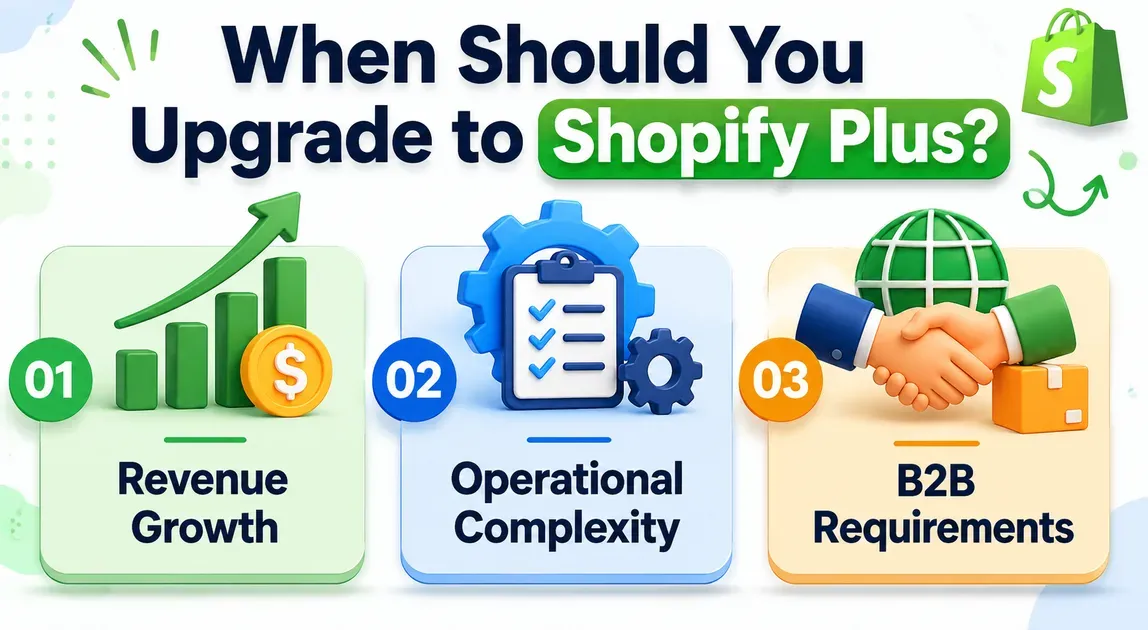
When Should You Upgrade to Shopify Plus?
Choosing between Shopify vs Shopify Plus often depends on your business growth stage and operational needs. While standard Shopify plans work well for many ecommerce stores, fast-growing brands may eventually need the advanced capabilities offered by Shopify Plus.
Here are the biggest signs that it may be time to upgrade from Shopify to Shopify Plus.
Revenue Growth
As a basic rule of thumb, companies typically look to upgrade when their gross merchandise value (GMV) approaches or exceeds $1 million to $2 million in annual sales.
From a pure math perspective, Shopify Plus offers significantly lower credit card processing rates (around 2.15% + $0.30 in the US and drops the third-party gateway fee down to just 0.20% if you don't use Shopify Payments. Once your transaction volume is high enough, the money you save on processing fees alone can dramatically offset the cost of the Plus subscription.
Operational Complexity
As businesses grow, daily operations often become more difficult to manage manually. Multiple apps, workflows, international stores, and customer segments can create operational challenges.
One of the biggest differences in the Shopify vs Shopify Plus features comparison is operational flexibility. Shopify Plus provides:
Advanced automation workflows
Better multi-store management
Custom checkout experiences
Improved backend efficiency
Higher API limits for integrations
These features help large businesses reduce manual work and improve scalability.
B2B Requirements
Businesses focused on wholesale or B2B ecommerce are often strong candidates for Shopify Plus. In the Shopify Plus vs Shopify Basic comparison, B2B functionality is one of the areas where Shopify Plus clearly stands out.
Shopify Plus may be the better solution if your business requires:
Company accounts
Custom wholesale pricing
Net payment terms
Separate B2B storefronts
Bulk ordering workflows
These built-in tools help simplify wholesale management while improving the buying experience for business customers.
FAQs
How much does Shopify Plus cost?
In terms of Shopify vs Shopify Plus cost, Shopify Plus pricing typically starts around $2,300 per month, although the final price can vary depending on sales volume and business requirements. Standard Shopify plans generally range from $39 to $399 per month.
What is the difference between Shopify and Shopify Plus?
The biggest difference in the Shopify vs Shopify Plus comparison is that Shopify Plus includes enterprise-level features for larger businesses. These include advanced checkout customization, better automation, higher API limits, B2B tools, multi-store management, and priority support.
Standard Shopify plans are usually better suited for small and medium-sized ecommerce stores.
Is Shopify Plus worth it?
Whether Shopify Plus is worth it depends on your business needs. In the Shopify vs Shopify Plus pricing discussion, Shopify Plus has a much higher monthly cost, but it also provides advanced features that can improve scalability and operational efficiency.
For high-growth brands, international stores, or B2B businesses, Shopify Plus can deliver significant long-term value. However, smaller stores may not fully benefit from the additional enterprise features.
Conclusion
When comparing Shopify vs Shopify Plus, the right choice depends on your business size, revenue, and operational complexity. Standard Shopify plans offer excellent value for small and medium-sized businesses, while Shopify Plus is designed for enterprise brands that need advanced customization, automation, and scalability.
If your business is expanding rapidly, managing multiple storefronts, or scaling wholesale operations, Shopify Plus may provide the flexibility and infrastructure needed for long-term growth. Otherwise, standard Shopify plans remain a powerful and cost-effective ecommerce solution in 2026.

Hey! I'm Linda Bui. Join me as we explore tips and tutorials about Shopify apps and Shopify themes for your Shopify store.
Start Building Trust Today
Install the Product Reviews app to improve your store's credibility and boost sales with real customer reviews.
Get Started with Zero CostWhat to not miss out on our blog
Gain insightful knowledge and invaluable experiences from dedicated experts.
_1200x630.webp)
What Is Shopify Collabs? How It Works and How Brands Use It in 2026
Discover what is Shopify Collabs, how it automates affiliate tracking, and how to use it to scale influencer marketing from your dashboard. Read right now!
_1200x630.webp)
_1200x630.webp)
Newsletter
Get all the stories you need-to-know from the most powerful name in news delivered first thing every morning to your inbox