Shopify Starter vs Basic: Which Plan Should You Choose?
Shopify Starter vs Basic is one of the most common comparisons for new entrepreneurs launching an online business. While both plans let you sell products using Shopify’s ecosystem, they are built for very different goals. In this guide, we'll compare Shopify Basic vs Starter pricing, features, transaction fees, branding capabilities, SEO potential, and long-term value to help you choose the right Shopify plan for your business in 2026.
Quick Comparison: Shopify Starter vs Basic Plan at a Glance
To give you an immediate overview of how these two entry-level options stack up, here is a direct summary of the Basic vs Starter Shopify features.
| Feature | Shopify Starter | Shopify Basic |
|---|---|---|
| Monthly Price | $5 USD | $25 USD |
| Transaction Fees | 5.0% per sale | 2.9% + 30¢ USD per online transaction |
| Full Online Store | No (Simple product pages only) | Yes (Fully customizable website & blog) |
| Custom Shopify Domain Website | No (Uses shopify.com redirect) | Yes (Connect your own brand domain) |
| Shopify Themes | No | Yes |
| Blog Functionality | No | Yes |
| SEO Features | Very Limited | Full SEO Tools |
| Product Pages | Basic product links | Complete product catalog |
| App Store Access | Limited | Extensive |
| Inventory Management | Basic | Advanced |
| Best For | Social selling & testing ideas | Building a long-term ecommerce brand |
What Is Shopify Starter?
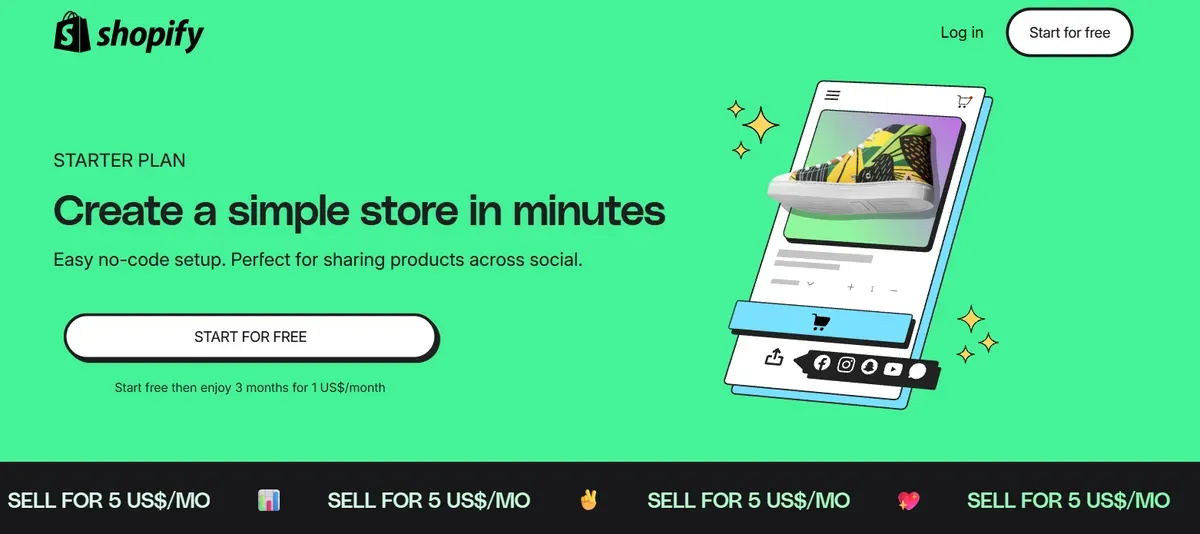
The Shopify Starter plan is the company's absolute entry-level tier. It is designed specifically for individuals who want to sell products without the complexity, time investment, or cost of building a full-scale website. When weighing Shopify starter vs basic, the biggest takeaway is that Starter doesn't give you an independent storefront. Instead, it gives you the back-end power to accept secure payments anywhere you can paste a link.
What Is Included in the Shopify Starter Plan?
When comparing Shopify Starter vs Basic, we need to mention features. These are 4 main features in the Shopify Starter Plan:
Starter pricing: At just $5 per month, it is the most affordable way to access the Shopify ecosystem. However, it comes with a higher 5.0% transaction fee per sale, meaning Shopify takes a larger cut of your revenue in exchange for the low subscription cost.
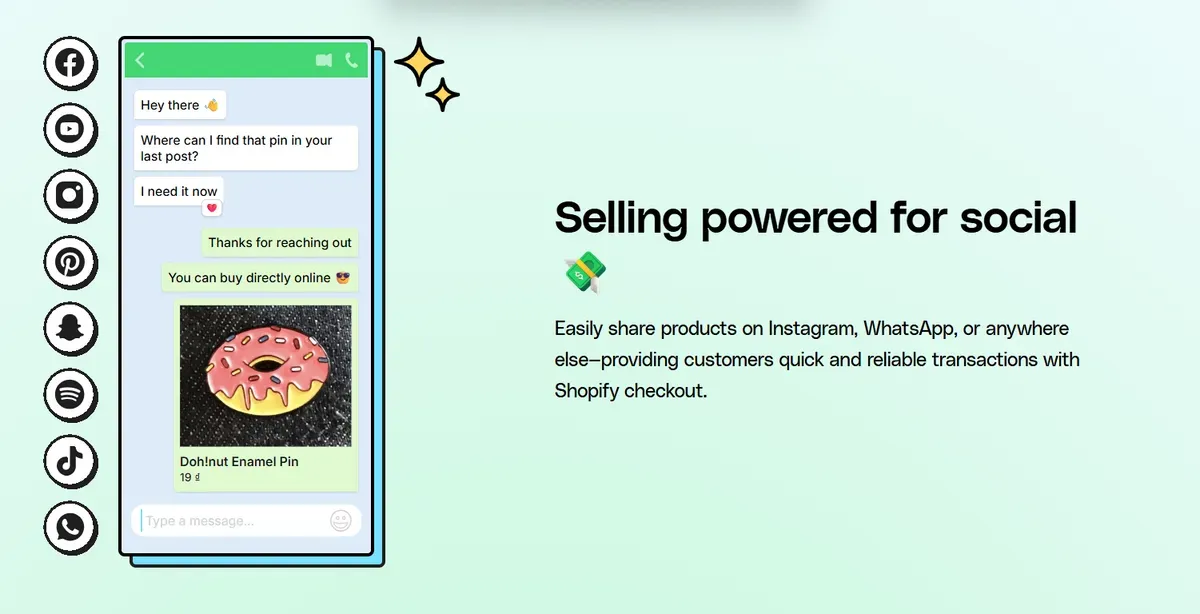
Sell through social media and messaging apps: This plan is built entirely around social commerce. You can generate clean product links and easily share them across platforms like Instagram, TikTok, Facebook, WhatsApp, and YouTube, or send them directly via text messages to buyers.
Product links and simple storefront: You do get a lightweight, mobile-optimized homepage called the "Spotlight" theme. It serves as a simplified product catalog page where customers can browse a basic list of your items, but you cannot add custom pages, headers, or footers.
Shopify Checkout: Even though you don't get a real website, your buyers still experience the industry-standard, secure Shopify Checkout interface. It processes credit cards safely, calculates local taxes, and handles order confirmations smoothly.
Pros of Shopify Starter
Lowest-cost Shopify plan: At a fraction of the cost of traditional ecommerce hosting, it carries incredibly low financial risk for creators and casual hobbyists.
Easy setup for beginners: You don't need to know how to design a website, configure layouts, or write code. You simply upload a product photo, set the price, and you are ready to sell in under 10 minutes.
Good for testing products: If you want to validate a new product concept, gauge market demand, or sell limited-edition merch to an existing audience, it is an excellent tool to test the waters.
Cons of Shopify Starter
No full online store: You cannot build a destination website. There is no navigation menu, no "About Us" page, and you cannot group your items into organized categories or collections.
Limited branding and customization: You cannot change fonts, adjust colors deeply, or use custom themes. Every merchant on this tier uses the exact same rigid layout, making it hard to stand out.
Minimal SEO capabilities: Because there are no indexable website structures, blog posts, or custom metadata fields, it has an almost zero organic footprint. You cannot use search engine optimization (SEO) to attract traffic from Google; you must bring your own audience from social media.
What Is Shopify Basic?
The Shopify Basic plan is the first true e-commerce tier offered by the platform. It provides everything an entrepreneur needs to build, launch, and scale a fully independent digital storefront. When analyzing Shopify starter plan vs basic, the Basic tier represents the step up from casually sharing sales links to owning an established, professional retail website under your own brand identity. Let's discover Shopify's basic plan to weigh Shopify Starter vs Basic.
What Is Included in the Shopify Basic Plan?
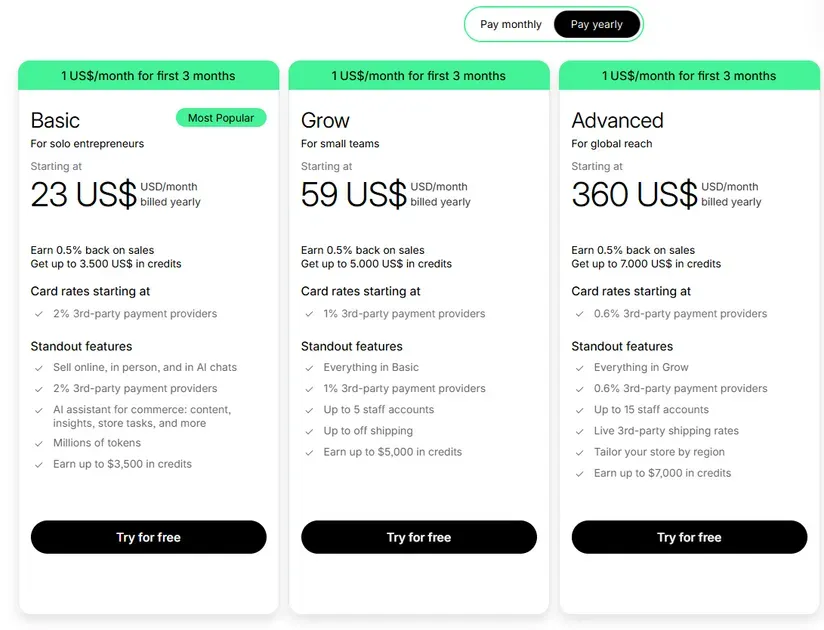
Comparing Shopify Starter vs Basic ,Shopify Basic Plan shows more features compared to the Starter plan:
Full ecommerce website: Unlike the restriction-heavy alternatives, you get a completely standalone website. You can create unlimited content pages (like "Our Story," "Contact Us," or size guides), build intuitive navigation menus, and organize your inventory into distinct product collections.
Online store themes: You gain full access to the Shopify Theme Store. This allows you to choose from dozens of free and premium themes built on the advanced Online Store 2.0 framework, giving you drag-and-drop control over your store's exact layout and design.
Blog functionality: It includes a native, built-in blogging platform. This is a massive feature for inbound marketing, allowing you to publish articles, lookbooks, and guides to engage your audience and build brand authority.
SEO tools: You get deep search engine optimization control. You can customize your Shopify URL structure, edit meta titles and descriptions, and generate automatic sitemaps to ensure your store indexation works flawlessly on search engines.
Inventory and order management: The robust backend allows you to track inventory across multiple physical locations, print shipping labels directly from your dashboard, and set up advanced shipping profiles based on weight, price, or zone.
Pros of Shopify Basic
Complete ecommerce solution: It provides all the necessary tooll, from marketing features to payment processing, required to run a serious online business without needing external hosting.
Better customer experience: Features like automated abandoned cart recovery emails, customer account creation, and gift card support help increase your conversion rates and build customer loyalty.
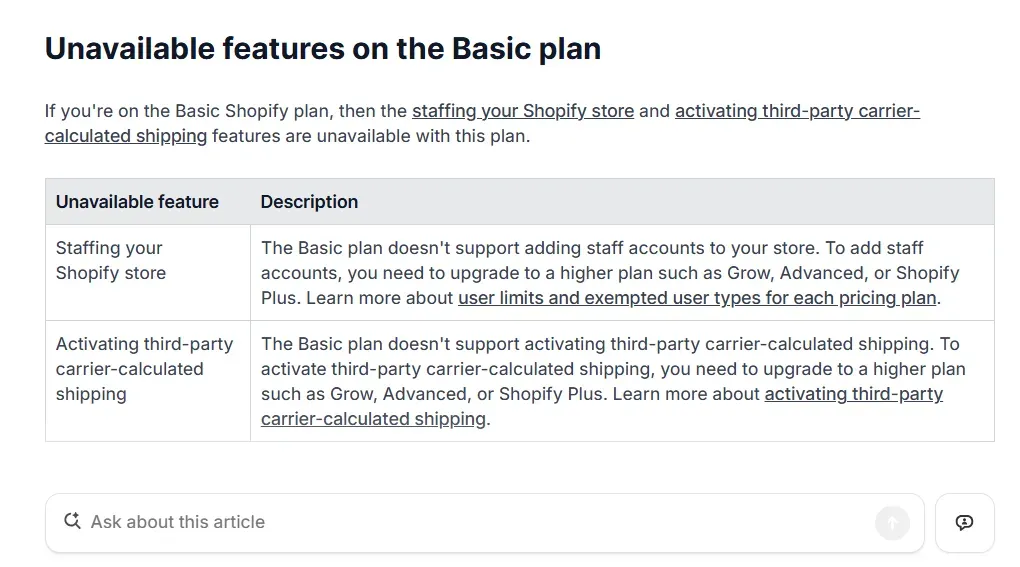
Supports long-term growth: Shopify Starter vs Basic, Basic plan scales smoothly. It allows for up to two staff accounts and unlocks unlimited product listings, meaning your website infrastructure won't choke as your traffic and catalog expand.
Cons of Shopify Basic
Higher monthly cost: At $39 per month, it requires a much larger upfront financial commitment than the simpler $5/month option.
More setup required: Because you are building a legitimate website from scratch, configuring your theme, setting up your domain, and organizing your collections takes time, effort, and a steeper learning curve for beginners.
Key Differences: Basic vs Starter Shopify Detailed Breakdown
To truly understand how the Shopify starter vs basic plan choice affects your day-to-day operations and profit margins, we need to look past the surface features. Let’s dive into a detailed, head-to-head breakdown of the four core pillars that separate these two tiers.
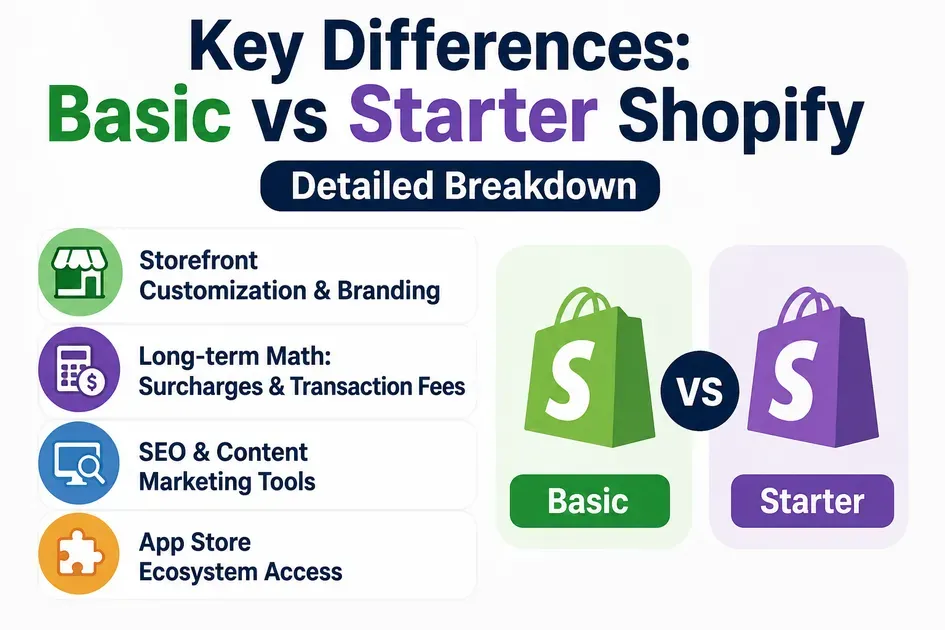
Storefront Customization & Branding
Starter: This plan ties your business exclusively to a rigid layout known as the "Spotlight" theme. Your options for custom design are minimal; you can upload a logo and tweak a couple of brand colors, but you cannot change fonts, move layout sections, or create custom landing pages.
Basic: This gives you full access to the Shopify Theme Store, unlocking dozens of free and premium themes. You get complete drag-and-drop control using sections and blocks, the ability to inject custom code (HTML/CSS), and total freedom over your branding elements.
Verdict: Shopify Basic wins hands down. If you want your store to look like a unique, trustworthy brand rather than a generic template, Starter simply cannot deliver.
Long-term Math: Surcharges & Transaction Fees
Choosing between Shopify starter vs basic isn't just about the monthly subscription cost ($5 vs. $25), it's about the transaction fees.
Shopify Starter charges a steep 5.0% transaction fee per sale.
Shopify Basic charges a lower 2.9% + 30¢ per online transaction.
Because of this gap, there is a clear "tipping point" where the Starter plan actually becomes more expensive than the Basic plan. Let's look at the math:
The Tipping Point ($1,515/month): If your store processes more than $1,515 in monthly sales, the 5% fee on the Starter plan eats up more revenue than the flat $20 price difference to upgrade to Basic.
Verdict: Shopify Starter is only cheaper for low-volume sellers. The moment your sales start growing, the 5.0% fee actively drains your profits, making Basic the smarter financial choice.
SEO & Content Marketing Tools
Starter: This tier provides zero organic search footprint. Because it does not generate a standard website architecture, there are no indexable collection pages, no blogging engine, and no options to edit metadata. You cannot optimize your products to show up naturally on Google search results.
Basic: This plan includes robust, built-in blogging functionality and dedicated SEO tools. You can write content to target high-value keywords, customize your URL structures, and optimize meta titles and descriptions for every item you sell.
Verdict: Shopify Basic is essential for organic growth. If your marketing strategy relies on search engines, the Shopify starter vs basic choice is clear: Starter forces you to pay for social ads or bring your own audience, while Basic lets you build free traffic over time.
App Store Ecosystem Access
Starter: Your access to the Shopify App Store is highly restricted. You can only install a small, curated selection of apps designed for link sharing, basic shipping, and product fulfillment. Advanced tools for upselling, custom pop-ups, or deep email marketing automations are completely blocked.
Basic: This plan unlocks the entire Shopify App Store ecosystem, giving you access to thousands of integrations. You can install apps for dropshipping (like Zendrop or DSers), advanced loyalty programs, reviews, and complex inventory management systems.
Verdict: Shopify Basic wins for scalability. If you plan on running a modern e-commerce store that utilizes automated apps to increase average order value and streamline shipping, you will require the unlocked access of the Basic tier.
Shopify Starter vs Basic: Which Plan Is Better in 2026?
Choosing Shopify Starter vs Basic comes down to your current business assets, operational style, and target audience. Let’s look at which business models fit best into each plan to help you finalize your decision.
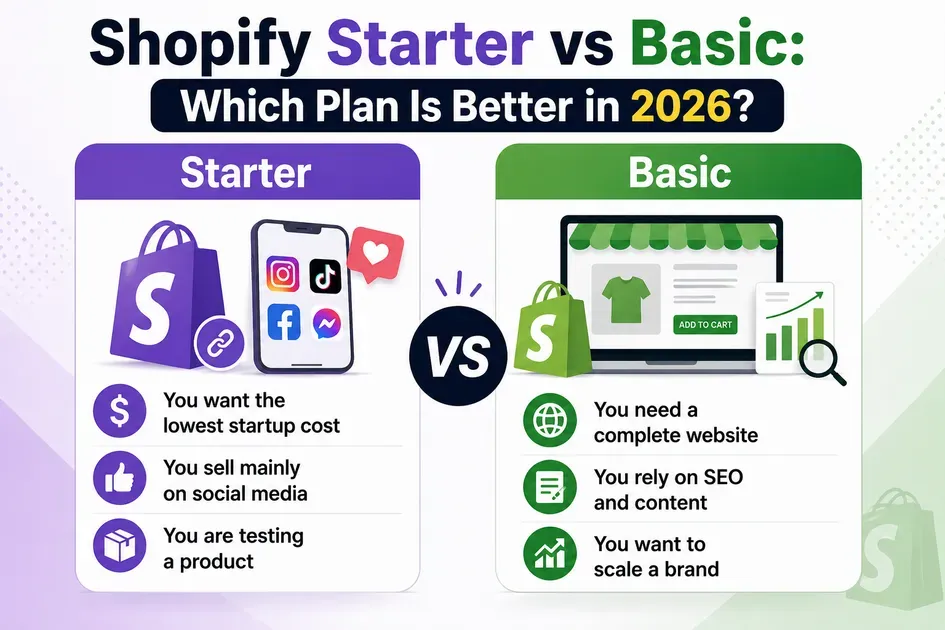
You should choose Shopify Starter if:
You want the lowest startup cost: You have a tight budget and want to test the waters for just $5/month.
You sell mainly on social media: You have an existing following on Instagram, TikTok, or YouTube and just need a clean "Link in Bio" checkout.
You are testing a product: You want to validate a single item or sell limited merch without building an entire store.
Ideal for: Content creators, influencers, digital artists, and hobbyists selling a few products directly to their social audience.
You should choose Shopify Basic if:
You need a complete website: You want a professional, multi-page digital home with navigation menus and custom pages.
You rely on SEO and content: You plan to write blogs, optimize product descriptions, and bring in free traffic from Google.
You want to scale a brand: You need fully customizable themes, marketing automation tools, and full access to the App Store.
Ideal for: Dropshippers, print-on-demand brands, local boutique owners expanding online, and startups building a long-term business.
FAQ
What are Shopify Starter plan limitations?
The Starter plan does not give you a full website, a custom domain name, or collection pages. It also restricts your access to the Shopify App Store, limits your design changes, and charges a high 5% transaction fee.
Does Shopify Starter plan give you a website?
No. It only gives you basic, mobile-optimized product pages and a secure checkout layout. You cannot build a complete storefront with navigation menus, a blog, or custom sub-pages.
Which Shopify plan is best for dropshipping?
When it comes to dropshipping, Shopify Starter vs Basic, Shopify Basic is the best choice. Dropshipping requires importing items via third-party apps (like DSers or Zendrop) and optimizing your store for search traffic (SEO), both of which are blocked on the Starter plan.
Is Shopify Starter worth it for beginners?
Yes, but only if you have a tight budget, want to test a product idea quickly, or plan to sell items exclusively using direct links on your social media profiles.
Conclusion
The choice between Shopify Starter vs Basic ultimately depends on how you plan to sell and scale your storefront. No matter which tier you choose to launch on, maximizing your sales requires the right tools to convert traffic into buyers. Doran apps offers a suite of powerful solutions designed to boost your storefront's revenue, engagement, and operational efficiency

Hey! I'm Linda Bui. Join me as we explore tips and tutorials about Shopify apps and Shopify themes for your Shopify store.
Start Building Trust Today
Install the Product Reviews app to improve your store's credibility and boost sales with real customer reviews.
Get Started with Zero CostWhat to not miss out on our blog
Gain insightful knowledge and invaluable experiences from dedicated experts.
_1200x630.webp)
What Is Shopify Collabs? How It Works and How Brands Use It in 2026
Discover what is Shopify Collabs, how it automates affiliate tracking, and how to use it to scale influencer marketing from your dashboard. Read right now!
_1200x630.webp)
_1200x630.webp)
Newsletter
Get all the stories you need-to-know from the most powerful name in news delivered first thing every morning to your inbox